
Pageant Posing Guide
Posing is a feature of the Babyz game in which babyz will make certain specific faces towards the camera. It was designed to go along with the built-in voice recognition feature which, at the time, was a fairly novel thing for a game to have. When babyz "hear" your voice through the microphone, they will react! Their eyes will become wide and alert, and they will aoften gasp, smile, and laugh in response to your voice as well as cheesing a little for the camera. These reactions are what we refer to as posing.
Recognizing Poses
If you are newer to Babyz or pageanting, it may be hard to tell when a baby is actively posing or not.
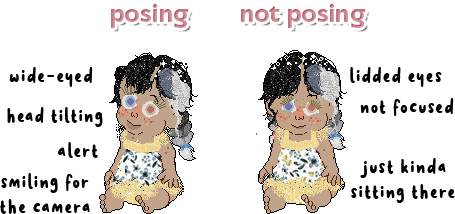
You can tell that a baby "hears" your voice and is in posing mode when they appear wide-eyed, alert, aware of the camera/you, tilting their head, making eye contact, and smiling for the camera.
If they can't hear you or they're distracted by something else in the room, they'll be unfocused, maybe not quite looking at the camera. Their eyes will be soft and lidded, and they'll sort of just be sitting there doing nothing.
When they're in posing mode, that's a good time to try getting pageant poses!
Taking Pageant Photos
The most important thing you need to get your baby posing is a way for them to "hear" you! Babyz respond to sound coming into the microphone which triggers the wide eyes and better posing. any sound will do, as long as they are hearing sound.
If you can't get viavoice to work, there is a great workaround in Prism's Petza addon where you can just press Q or P on your keyboard and the game will think it hears a sound.
Once your babyz can hear you, you can start getting them posing!
How do I get my baby on their knees?
Changing Room Method: Take your baby to the changing room. There, to get them on their knees, you can rapidly remove and place clothing on them as that often triggers them to get onto their knees.
Backyard Slide Method: Take your baby to the backyard and place them in the top left corner behind/beside the slide. If you pick them up and plop them a few times they should eventually get on their knees.
Once they are on their knees, tickle them to start getting poses. If they start to shift positions, a well-timed tickle will get them back onto their knees. This does take a bit of trial and error to get the timing down! Setting your game speed slower can help to catch all the poses as well.
Photo Taking Methods
Two popular methods of capturing great pageant photos are autosave vs. timing your photos.
Autosave is an option in your game's settings, and also in the photo pop-up that you get when you first take a photo ingame with spacebar. Many players find that autosave helps them to capture good poses more easily, as you can simply hold down spacebar to rapid-fire photos and catch almost every frame as they pose. This method is a bit more random, and after a photo session you'll have to go into your Babypix folder and sort out the photos you want to keep. (Note: if using Petza's Q button rather than Viavoice with this method, you'll have to alternate Q, tickle, spacebar rather than holding it down, in order to get consistent poses.)
The timing method does not use autosave, so it is definitely harder to master, but can give you more controlled results. With this method, you use the ingame photo popup to take photos as your baby is posing. You can visually see each photo and quickly decide in the moment if you want to save the photo or try again. After some practice with this method, you'll start to learn the right timing to catch the best poses, and you won't have to sort and delete a million photos as you do that in the moment instead. However, it can cause you to miss some poses while you are reviewing and saving the photos.
Neither method is more correct than the other, it's just up to your own personal preference! Give both a try and see which one you prefer.
Types of Pageant Poses
There are several types of poses that are considered "pageant poses" and there are standards and best practices with each one.
Standard Pose (Big Smile)
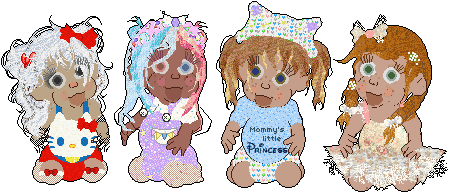
The pageant standard pose is a big, wide, happy smile, often referred to as the big smile, wide smile, or simply :D face. This pose will always be preferred and score the highest when compared to other poses. It is considered to be the pageant standard, and whenever a pageant is not themed around a specific pose, you should always strive to enter a big smile photo.
The best-executed big smiles will have the following features:
Wide open eyes (no half-lids)
Baby looking at the camera
Smooth lip lines with upturned smiling corner(s)
Smooth facial lines (no weird noses/lips/eyes)
Baby sitting on their knees
Baby looks like they did this pose on purpose (not while dancing or being tickled, etc.)
Since pageant judging is always going to be somewhat subjective and based on personal preference, some judges will be more of a stickler for these things than others.
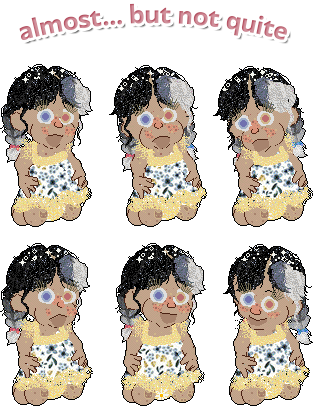
Above you can see a compilation of photos that are almost right, but would be unlikely to place in a pageant as they do not meet the standard. The majority of these suffer from awkwardly shaped mouths and faces.
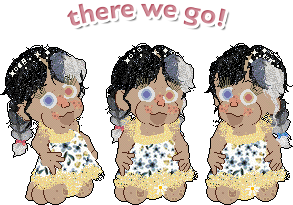
The ideal version of the "big smile" pose should be a big, happy, wide-mouthed smile with sharply upturned corners. The baby should actually look happy! Think "laughing" rather than "shouting". Both cheeks should be full and round, and the proportions should be such that the face doesn't look squashed or awkward.
Non-Standard Poses
Non-standard poses are any defined pose that is not the standard big mouth smile. Defined pose meaning that non-standard is not to be confused with "anything goes" style photos; the non-standard poses are still specific poses, each with their own ideals and scales of quality.
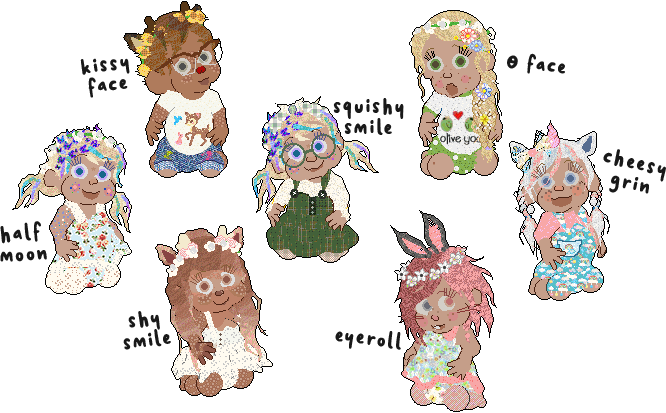
When pageanting, it's very important to master not just the standard big smile but also the non-standard poses, as they are very commonly used as pageant themes. In this section, I will go over specific non-standard poses, what differentiates them from similar poses, and what the best versions of each pose are.
Shocked Face & Kissy Face
Shocked face and kissy face are the two main "O" shaped mouth poses that babyz do. They can sometimes seem similar, but it is super important to note that they are two different, distinct poses that are not interchangeable.
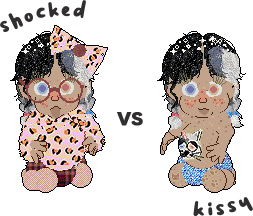
The biggest difference between these two poses is that the shocked face, or "big O" face is a larger, more oval-shaped O where they appear shocked or amazed. The kissy face, on the other hand, is a small, more puckered o shape, that looks like they are blowing a kiss.
So, when a pageant calls for an O face or a shocked face, they will be referring to the bigger O. If the pageant says kissyface, that's when they are wanting the smaller o. You should do your best to enter the correct mouth shape for the correct theme, as if you enter a shocked face in a kissy pageant or a kissyface in a shocked pageant, it likely will not perform well.
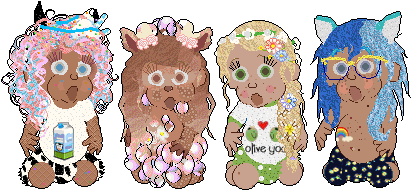
The mark of a good shocked/big "O" face is an almost perfectly oval-shaped mouth with wide eyes looking at the camera. Heads can be angled or tilted like big smiles, but the eyes should always be wide like they are shocked or saying "wow!"
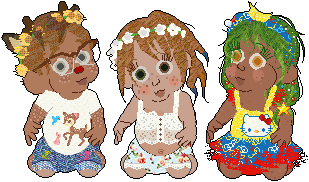
Conversely, the mark of a good kissy face is a small "o" or upside-down triangle shaped mouth that looks like they are puckering up for a kiss. Like all poses, they should have wide open eyes and be looking at the camera.
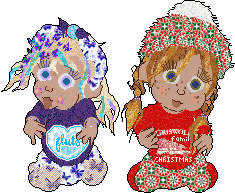
Babyz will also often make big and small "O" faces after you put clothes on them, with their arms up like they are checking out their outfit, as seen above. While super cute, that is actually a different pose, often called "how do i look" or "who, me?" - so would also not be ideal for a shocked or kissy face pageant as they are not doing it purposely in the same way.
Squishy Smile & Shy Smile
Squishy smile & shy smile are the two main closed-mouth smile poses that babyz do. These two poses are sometimes confused as well by those newer to pageants or posing, but it's super important to know the difference as they are two distinct poses as well and are not interchangeable.
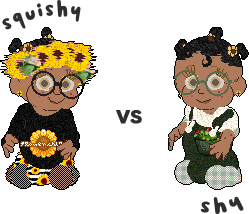
Though they may look similar at first, the main difference between a squishy smile and a shy smile is the wideness and "cheesiness" of the smile. The squishy smile is a much wider, more excited looking grin, while the shy smile is much smaller and looks more hesitant and shy. It's important not to mix the two smiles up and enter a squishy smile in a shy smile pageant or vice versa, as they will likely not perform well.
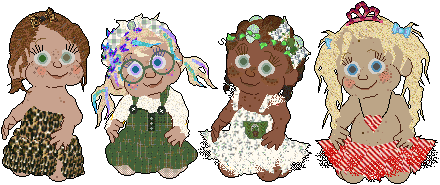
The squishy smile was named after the way the cheeks squish up when they they are doing this smile. The mark of a good squishy smile (though it is also known as wide smile or wide grin) is a true smile from cheek to cheek, which makes the baby look very happy or excited, sometimes even cheeky. You will also often see some mouth pixels above the mouth line - and that is actually normal/expected for this pose as it increases the personality of it.
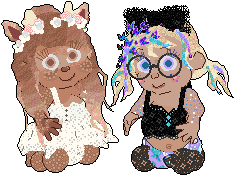
The shy smile is a much smaller smile, and it looks exactly as it sounds. Sometimes you'll get shy smiles while a baby is warming up to you, or before they start really posing. It's important to note that even with the shy smile, the eyes should still be wide open to show that the baby is alert and posing. Another thing of note is that shy smiles should really only be entered in pageants specifically for shy smiles as they are the weakest of the non-standard poses and are unlikely to place high outside of a pose-specific pageant.
Halfmoon Smile & Cheesy Grin
The halfmoon smile and the cheesy grin are the two main smaller open mouth smile poses that babyz do. These two are VERY similar, but they are two distinct poses.
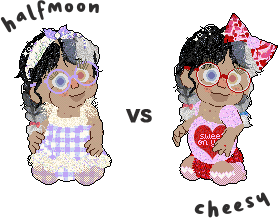
Halfmoon smiles are named after their shape, which is sort of a half or crescent moon. Sometimes people call it the "smaller :D face", it is essentially the little sibling of the standard big smile. The mouth is not open so large, but it is still open with smiling corners.
Cheesy grins, though they make a similar halfmoon shape, are a wider open smile, usually with a more "wiggly" top lip. I consider them kind of a mix between a halfmoon and a squishy smile as they are more of a wide, cheeky looking grin.
Though the two poses are different, there are times when you might capture something that seems sort of in between, like this:
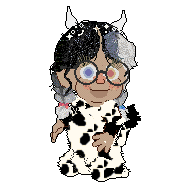
Unlike the other pose sets mentioned so far, there is a tiny bit of grey area between the halfmoon smile and cheesy grin. In those cases, there is often leeway given when those in between versions are entered. In this case, I would personally say that the above image is closer to a cheesy grin than a true halfmoon smile, but other pageant hosts may have different opinions.
Wildcard Poses
The term "wildcard pose" is used here to define anything that is ULTRA specific or outside the norm of regular posing standards. While these do technically still fall under the umbrella of non-standard poses, they tend to break the usual rules of posing.
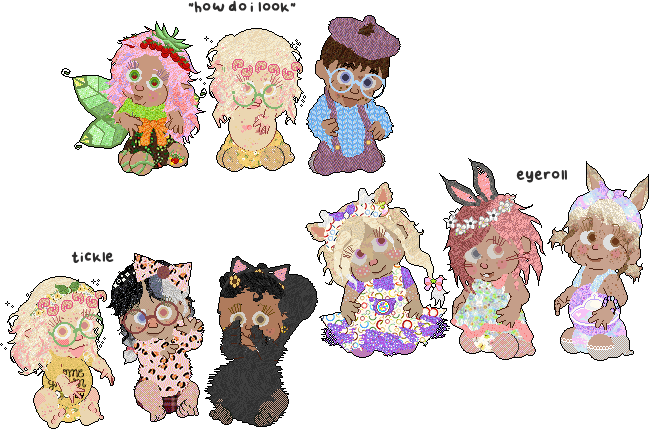
There are a lot of poses that can be defined as wildcard, but i have shown examples of some of the most common ones above.
"How do I look" is the pose (or series of poses) that babyz do when you put clothes on them. they will lift their arms as if touching their clothing, look down and at you, and sometimes also make kissy or shocked mouth faces.
Eyerolls are the most common of the wildcard poses, but are still considered wildcards since the pose is done primarily with the eyes rather than the mouth. A pose is considered an eyeroll when the face is forward or mostly forward, but the pupils themselves are looking in another direction - not when babyz turn their head to look somewhere else. As eyerolls can be a little bit difficult to identify and achieve, there is a detailed section on eyerolls below.
Tickle poses are exactly that - when babyz are being tickled! They can often make some really cute places but since their limbs flail all over the place and their expressions can't really be standardized, that's what makes this a wildcard. Easily replicable but rarely the same twice!
Other examples not shown above are angry/sad faces, closed eye poses, and anything else that feels like a commonly-seen, easily replicable pose that also breaks the usual posing rules a little bit. Because of this distinction, wildcard poses should be reserved only for anything goes pageants or pageants that are specifically themed around those poses.
Eyerolls
Since eyerolls are somewhat elusive poses, this extra section has been added to explain the best methods of capturing an eyeroll.
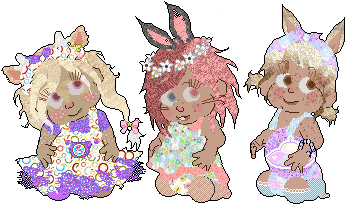
The best examples of eyerolls are when the pupils are the ones doing the moving, not the face. The face should be forward, or mostly forward, with the eyes themselves looking in another direction.
The "personality" shown in an eyeroll photo could be described as coy, shy, or like they know a secret or are playing innocent.
Generally, the eyes should be rolling upwards or to the side, rather than downwards. And, like most poses, for best results, babyz should be sitting on their knees.
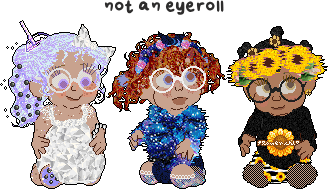
Above are examples of photos that would not be considered an eyeroll. In the first image, the baby is looking down rather than rolling her eyes. In the second image, the baby is doing what we like to call "looking" rather than eyerolling. You can tell by the position of the baby's head if they are "looking" instead of rolling their eyes. In the third image, the baby is eyerolling but her eyes are soft and lidded, not wide-open and alert like they should be.
It is important to know the difference between correct and incorrect eyerolls for a strong pageant portfolio as well as when judging an eyeroll pageant.
Eyeroll Methods
For a long time, eyerolls were considered the most difficult pose to achieve as there was no real way to "make" babyz do it. Often, if a baby is more prone to eyerolling, they will sometimes do it by themselves, but it was never a guarantee.
However, in the last couple of years, our member, Kittycat, discovered an easier, more replicable method of achieving eyerolls! This most "tried and true" method is to bring your baby to the backyard and place them behind the slide, as seen in Kittycat's gif below.
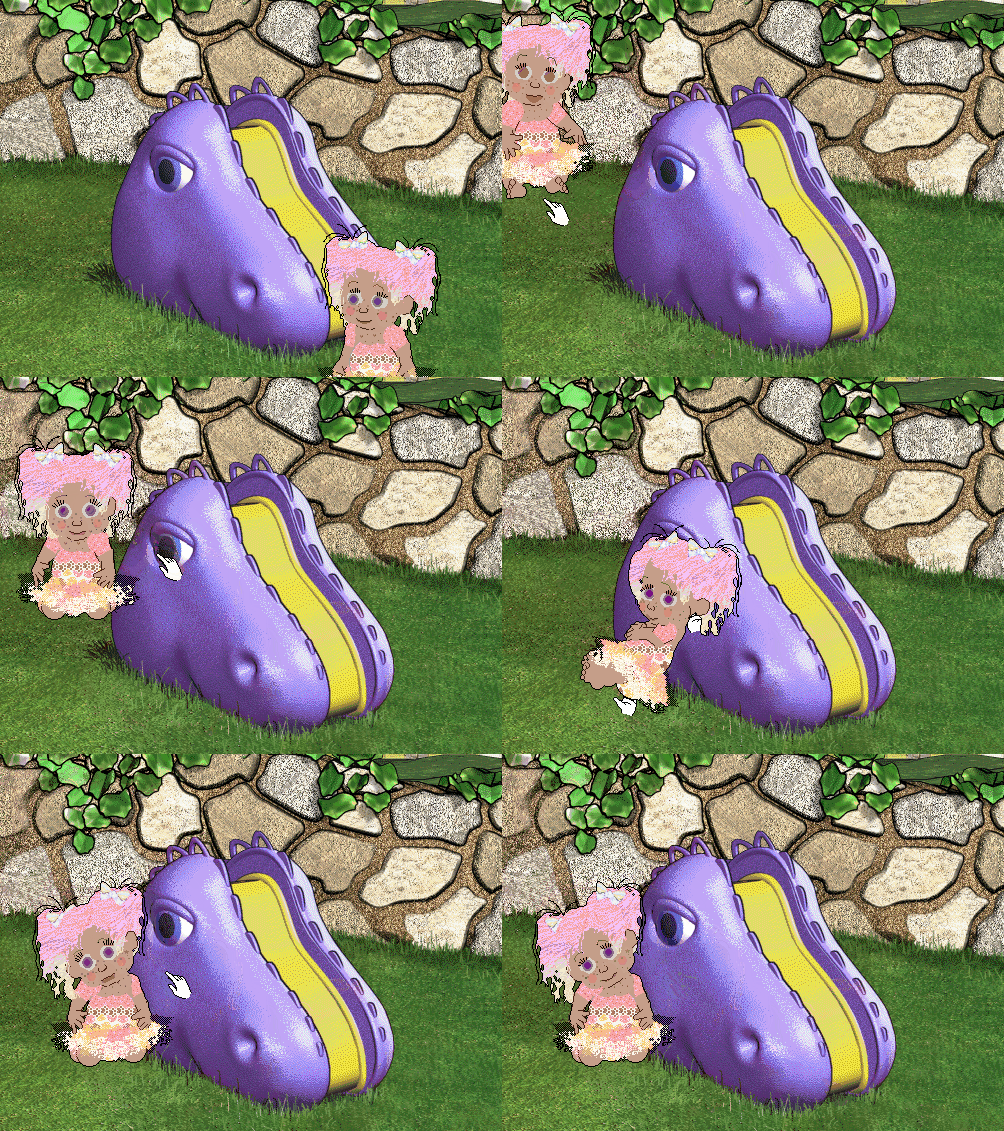
Even with this method it can sometimes take a little time and practice to get eyerolls out of them. I have found that the best way to use this method is to place them in that location, plopping them down multiple times until they get on their knees (which they often do naturally in this spot) and then wait before tickling or touching them. You can use viavoice or Q sparingly here just to ensure wide eyes, but in that moment of "nothing" they will often give you an eyeroll.